Practise for free: questions with explanations, and a full test simulator.
These are Daily K53 practice questions. We write our own questions; they are not copies of the official test. The vehicle-controls questions here are for a code 2 car.
Vehicle controls
In the test: 8 questions, pass mark 6 out of 8.
1. Before pulling away from the kerb, what must you do after checking your mirrors?
- A Sound the hooter to warn other road users
- B Signal, then check your blind spot over your shoulder ✓ correct
- C Nothing further - the mirrors show everything
Why: Mirrors do not cover the blind spot alongside and slightly behind you. Signal your intention, then look over your shoulder before moving off.
2. Which gear should you normally use to pull away on level ground?
- A First gear ✓ correct
- B Second gear
- C Third gear
Why: First gear gives the most pulling power for getting a stationary vehicle moving. Change up as the speed builds.
3. You are descending a long, steep hill. What is the best way to control your speed?
- A Hold the brake pedal down the whole way
- B Select a lower gear and let the engine help hold you back ✓ correct
- C Put the vehicle in neutral and coast
Why: A lower gear uses engine braking so the brakes do not overheat and fade. Coasting in neutral removes engine braking altogether and is dangerous.
4. You are parking facing uphill against a kerb. Which way should the front wheels point?
- A Away from the kerb ✓ correct
- B Towards the kerb
- C Straight ahead
Why: Facing uphill, turn the wheels away from the kerb so that if the vehicle rolls back the rear of a front wheel catches the kerb. Apply the parking brake as well.
5. When should you use your hazard lights?
- A When your vehicle is stationary and a hazard to others ✓ correct
- B When you are driving in heavy rain
- C When you are in a hurry
Why: Hazards warn others that your stationary vehicle is an obstruction, for example after a breakdown. They are not a licence to stop where you like.
6. A red light showing a person wearing a seatbelt flashes on the dashboard. What does it mean?
- A The airbag has been used
- B The doors are locked
- C A seatbelt is not fastened ✓ correct
- D The parking brake is off
Why: The seatbelt reminder light warns that the driver or a passenger has not fastened a seatbelt.
Road signs
In the test: 28 questions, pass mark 23 out of 28.
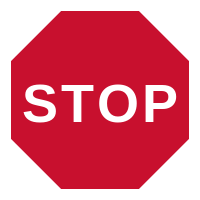
7. You reach this sign at a quiet crossroads at 2 a.m. No other traffic is in sight. What must you do?
- A Slow down and drive through if it is clear
- B Stop completely, then go when it is safe ✓ correct
- C Flash your lights and drive through
- D Stop only if a vehicle is coming
Why: This sign always requires a complete stop, even when the roads are empty. Only after stopping may you go on when it is safe.
8. This sign stands at an intersection where no stop line is painted. Where must you stop?
- A Just before the intersection, without entering it ✓ correct
- B Next to the sign, even if you cannot see
- C Inside the intersection where you can see
- D Anywhere within 50 m of the sign
Why: If there is no stop line, you stop before you enter the intersection. You must not stop inside it or in the path of crossing traffic.
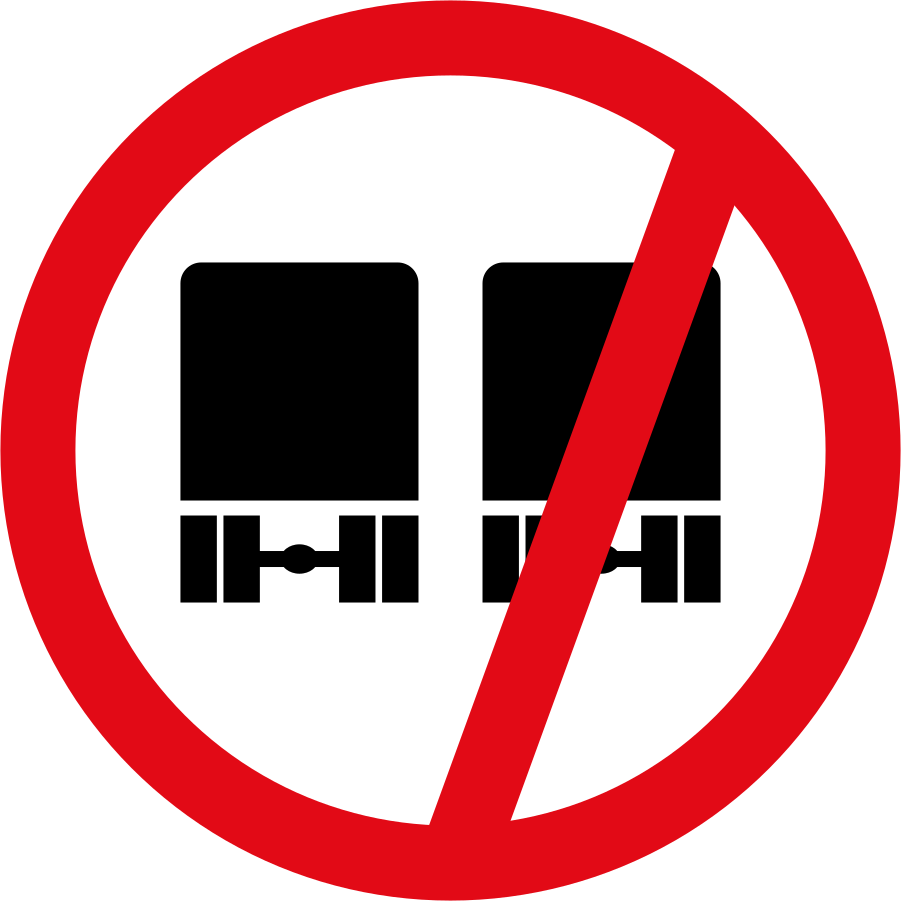
9. You drive a car. A slow truck is ahead on a clear, straight road with this sign. May you overtake the truck?
- A Yes, when safe, as the ban only stops goods vehicles overtaking other goods vehicles ✓ correct
- B No, nobody may overtake a truck here
- C No, nobody may overtake at all here
- D Only if the truck driver waves you past
Why: This sign, with two trucks, bans drivers of goods vehicles from overtaking other goods vehicles. It does not stop a car from overtaking when it is safe and legal.
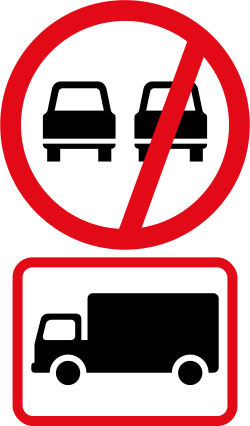
10. You drive a delivery truck. A slow bus is ahead on a road with this sign. May you overtake it?
- A Yes, the sign is only for cars
- B Yes, buses may always be overtaken
- C No, goods vehicles may not overtake here ✓ correct
- D Yes, if you hoot first
Why: The truck plate makes the no-overtaking sign apply to goods vehicles. As a truck driver you must stay behind the bus.
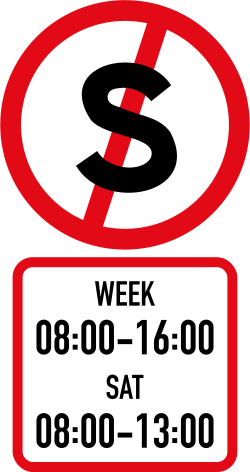
11. It is Sunday at 11:00. May you stop next to this sign?
- A Yes, the times shown do not include Sunday ✓ correct
- B No, the ban applies every day
- C No, Sunday counts as a weekday
- D Only before 08:00
Why: The plate lists only weekdays (WEEK) and Saturday. On Sunday none of the times apply, so the ban does not apply.
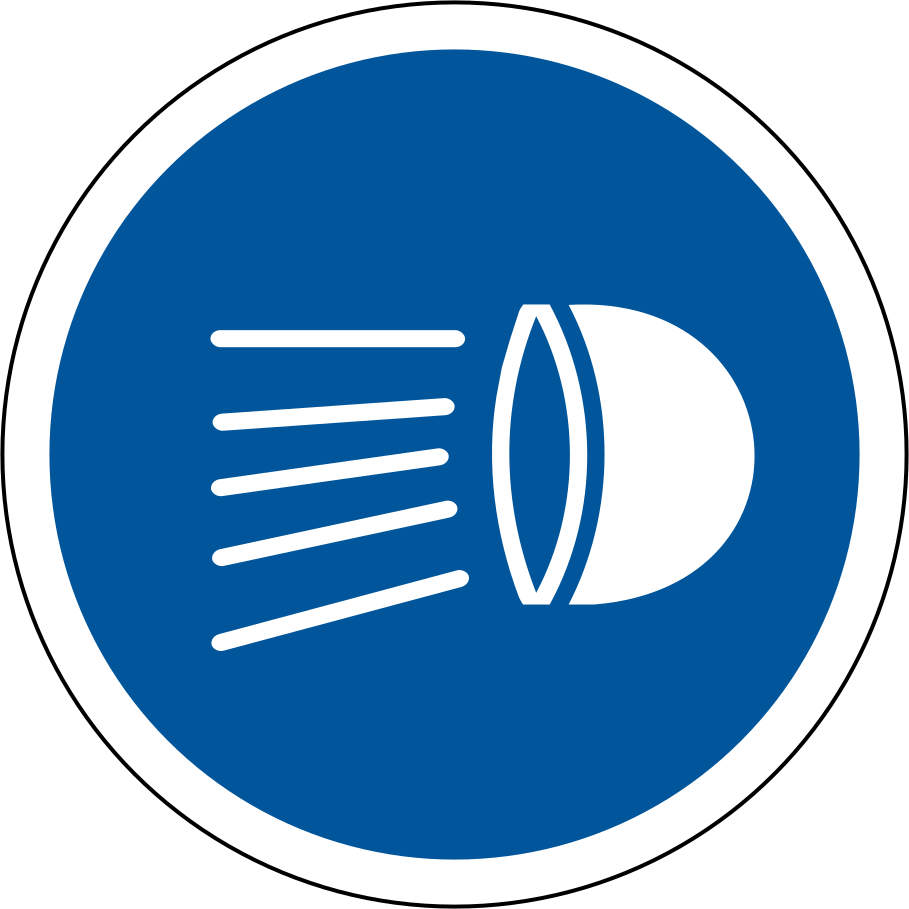
12. It is a bright, sunny day when you pass this sign. Must you switch on your headlamps?
- A No, only when it is dark
- B Yes, the sign applies in daylight too ✓ correct
- C No, only if it is raining
- D Only if you drive a truck
Why: This command sign has no time plate, so it applies at all times. Switch your headlamps on until a sign shows the section has ended.
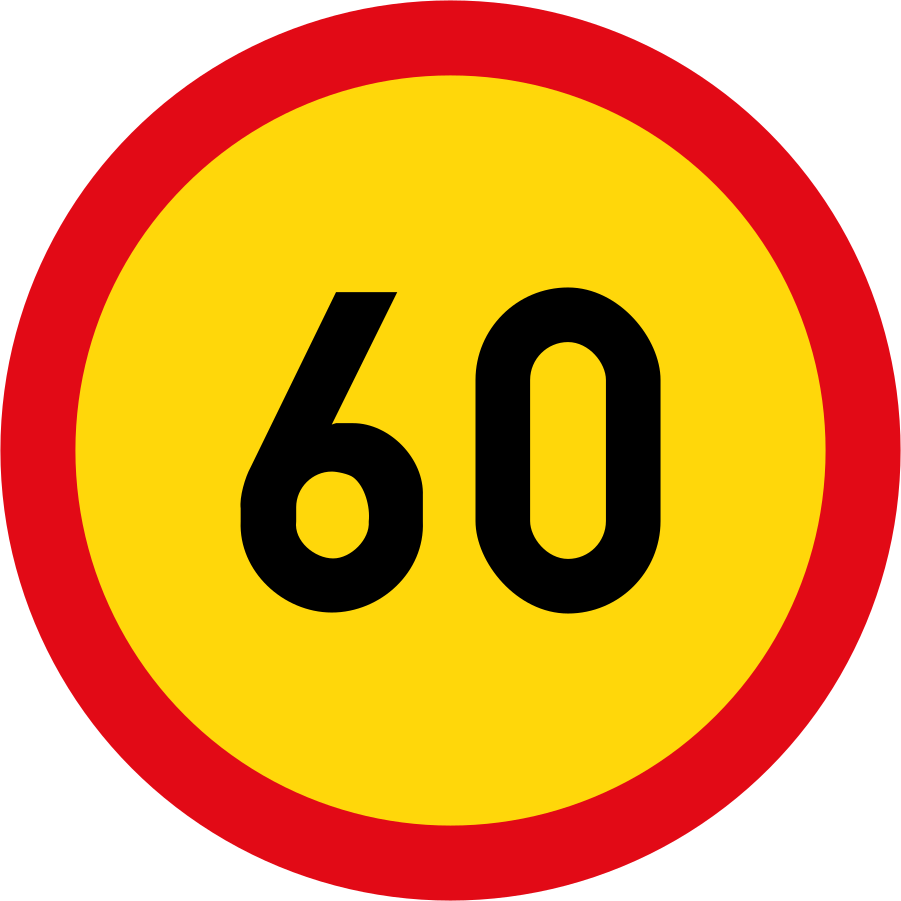
13. It is Sunday and no workers are in sight at the roadworks with this sign. What is your speed limit?
- A The normal limit, as nobody is working
- B 80 km/h, as it is a weekend
- C 60 km/h, as the sign still applies ✓ correct
- D There is no limit at roadworks
Why: A temporary speed limit sign applies whenever it is up, whether or not anyone is working. Road layouts at works can be dangerous at any time.
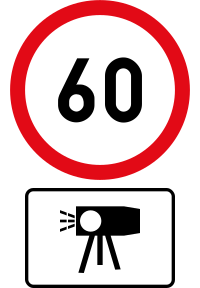
14. You pass this sign at 75 km/h and cannot see any camera. What should you do?
- A Keep 75 km/h, as there is no camera
- B Slow down to 60 km/h or less ✓ correct
- C Slow down only when you see the camera
- D Slow down to 70 km/h
Why: The 60 km/h limit is the law whether or not you see a camera. The plate only tells you that speed is checked here.
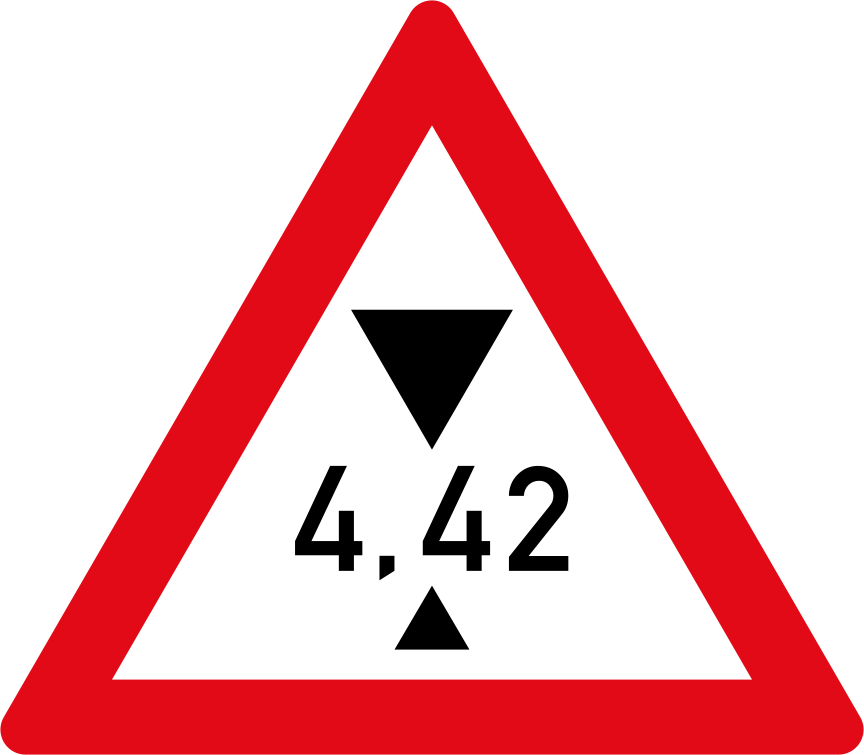
15. You drive a bus 3,8 m high and pass this sign. May you carry on?
- A No, buses may never pass this sign
- B No, only cars may pass
- C Only if you drive at walking speed
- D Yes, your bus is lower than 4,42 m ✓ correct
Why: The sign warns of a low clearance of 4,42 m ahead. A 3,8 m bus fits under it, so you may carry on with care.
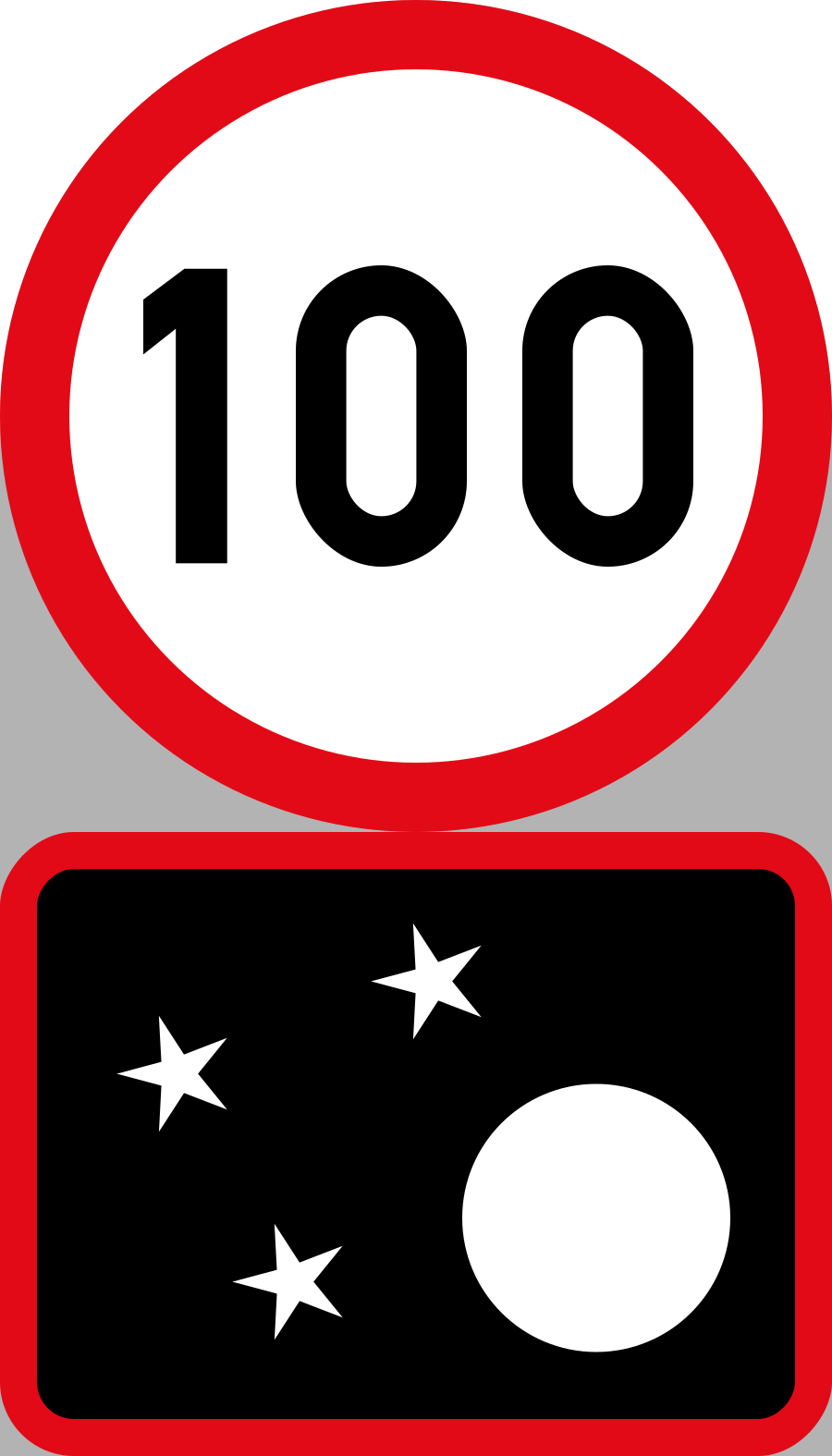
16. It is 14:00 on a sunny day and you pass this sign. Does its 100 km/h limit apply to you now?
- A Yes, it applies at all times
- B Yes, but only in bad weather
- C Only if you drive a goods vehicle
- D No, it applies only at night ✓ correct
Why: The plate with a moon and stars limits the 100 km/h sign to night-time. In the day another limit applies, such as one shown on another sign.
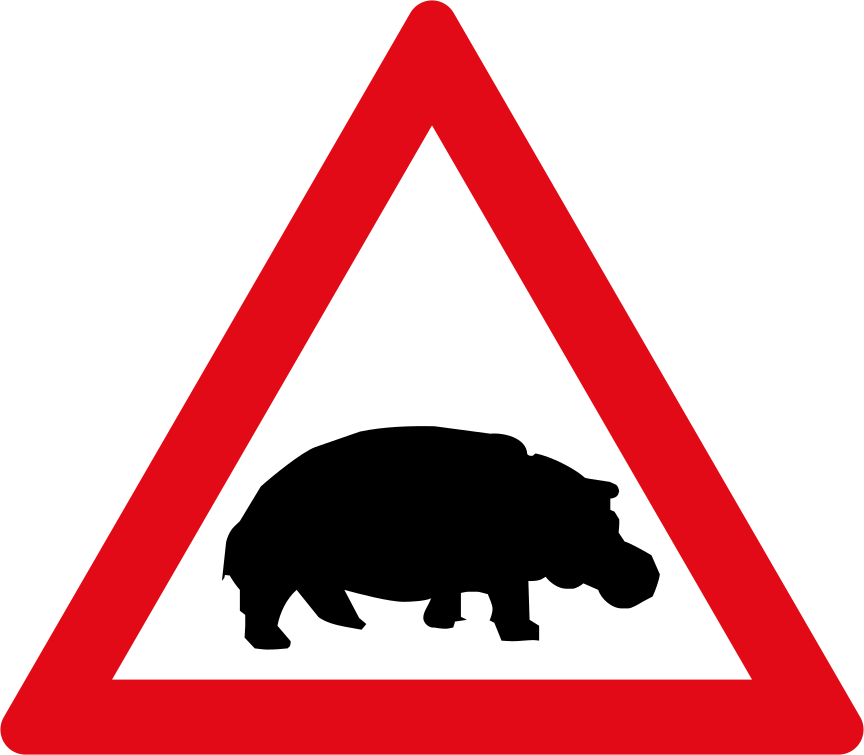
17. You drive along a river road past this sign after dark. Why should you slow down?
- A Hippos are only active at midday
- B The sign applies only to boats
- C The road is closed at night
- D Hippos often leave the water at night and may be on the road ✓ correct
Why: Hippos come out of the water to graze, mostly at night. A dark hippo on the road is hard to see, so drive slowly and watch carefully.
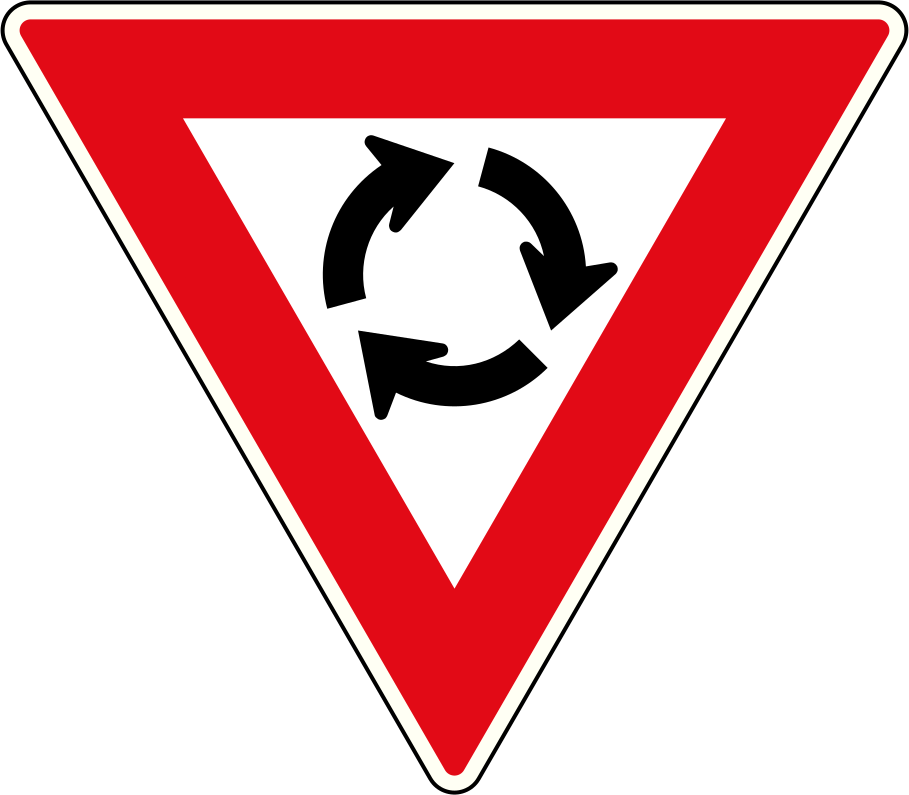
18. You reach a traffic circle with this sign. A car already in the circle is coming from your right. What should you do?
- A Enter first, as you are on the left
- B Let it pass, then enter when safe ✓ correct
- C Hoot and enter together
- D Flash your lights and enter
Why: This yield sign at a traffic circle means you must give way to traffic already in the circle, which comes from your right.
Rules of the road
In the test: 28 questions, pass mark 22 out of 28.
19. You leave a town and drive on an ordinary two-way country road. It is not a freeway and there are no speed signs. What is your speed limit?
- A 60 km/h
- B 80 km/h
- C 100 km/h ✓ correct
- D 120 km/h
Why: Outside an urban area, the general limit on a public road that is not a freeway is 100 km/h, unless a sign shows another limit.
20. You are driving in a town on a wide, empty road with no speed signs anywhere. May you drive at 80 km/h?
- A Yes, if the road is empty
- B No, the limit is 60 km/h unless a sign shows otherwise ✓ correct
- C Yes, wide town roads have an 80 km/h limit
Why: Inside an urban area the general limit is 60 km/h on every public road, wide or narrow. Only a sign can allow a higher speed.
21. You drive a bus on a freeway signposted 120 km/h. What is the highest speed allowed for your vehicle?
- A 120 km/h
- B 100 km/h ✓ correct
- C 80 km/h
- D 60 km/h
Why: Buses have their own maximum of 100 km/h, so a bus may not use the higher 120 km/h freeway limit.
22. At a four-way stop you stop first. A large truck stops on your right a moment later. Who goes first?
- A The truck, because it is bigger
- B You do ✓ correct
- C The truck, because it is on your right
- D Whoever moves first
Why: Order of arrival decides who goes first at a four-way stop. The size of the vehicle does not matter.
23. In good conditions you keep a two-second gap. What gap should you keep when the road is wet?
- A The same two seconds
- B One second, as you will be driving slower
- C Three car lengths
- D At least double, about four seconds ✓ correct
Why: Tyres grip less on a wet road, so you need more distance to stop. Doubling the gap to at least four seconds gives you that room.
24. You reach an intersection with no signs, robots or markings. A car coming from your left has already entered it and is crossing. What should you do?
- A Enter, because it came from your left
- B Hoot and drive through
- C Speed up to cross before it reaches your lane
- D Let it finish crossing before you enter ✓ correct
Why: A vehicle already in the intersection must be allowed to clear it. Entering at the same time would cause a collision, whoever came from which side.
25. In which direction do you drive around a traffic circle in South Africa?
- A Clockwise, with the central island on your right ✓ correct
- B Anti-clockwise, with the island on your left
- C Either way, whichever is shorter
- D Clockwise, with the island on your left
Why: South Africa drives on the left, so you turn left into the circle and travel clockwise around the central island.
26. You are stopped at a red robot and want to go straight. A green arrow pointing left comes on. What do you do?
- A Go straight, because a green light is lit
- B Move into the left lane and then go straight
- C Go if the car behind you hoots
- D Stay stopped until your green light comes on ✓ correct
Why: A green arrow is only for traffic going in that direction. For you the red light still applies.
27. The centre of the road has a broken line on your side and a solid line on the other side. May you overtake?
- A Yes, if it is safe; the solid line binds only oncoming traffic ✓ correct
- B No, any solid line means no overtaking for both sides
- C Only if you drive on top of the lines
- D Only at night
Why: Each driver obeys the line nearest to them. The broken line on your side lets you cross when safe; oncoming drivers may not cross their solid line.
28. A driver without a professional driving permit is tested after a roadblock. His blood alcohol is 0.06 g per 100 ml. What applies?
- A He is within the limit
- B He is over the legal limit of 0.05 g per 100 ml ✓ correct
- C The limit only applies to taxi drivers
Why: For ordinary drivers the blood alcohol limit is 0.05 g per 100 ml. A reading of 0.06 g is over that limit, which is an offence.
29. The sun set ten minutes ago and there is still some light in the sky. Must your headlamps be on?
- A No, only once it is completely dark
- B Yes, from sunset to sunrise they must be on ✓ correct
- C Only if street lights are on
- D Only on roads outside town
Why: Headlamps must be lit from sunset to sunrise, not only when it is fully dark. Dusk is when other drivers find it hardest to see you.
30. In a town street with no parking signs or markings, how close to an intersection may you park?
- A Right up to the corner
- B Not within 1 metre of it
- C Not within 5 metres of it ✓ correct
- D Not within 50 metres of it
Why: In an urban area you may not park within 5 metres of an intersection unless a sign allows it. Cars parked on the corner block the view of turning drivers.
Ready to test yourself? Write a full 64-question practice test, marked section by section.
More K53 guides
Not official: Daily K53 is an independent learning aid, not affiliated with the RTMC or the Department of Transport. We work hard to keep this right, but the road traffic regulations and your testing centre are what count.